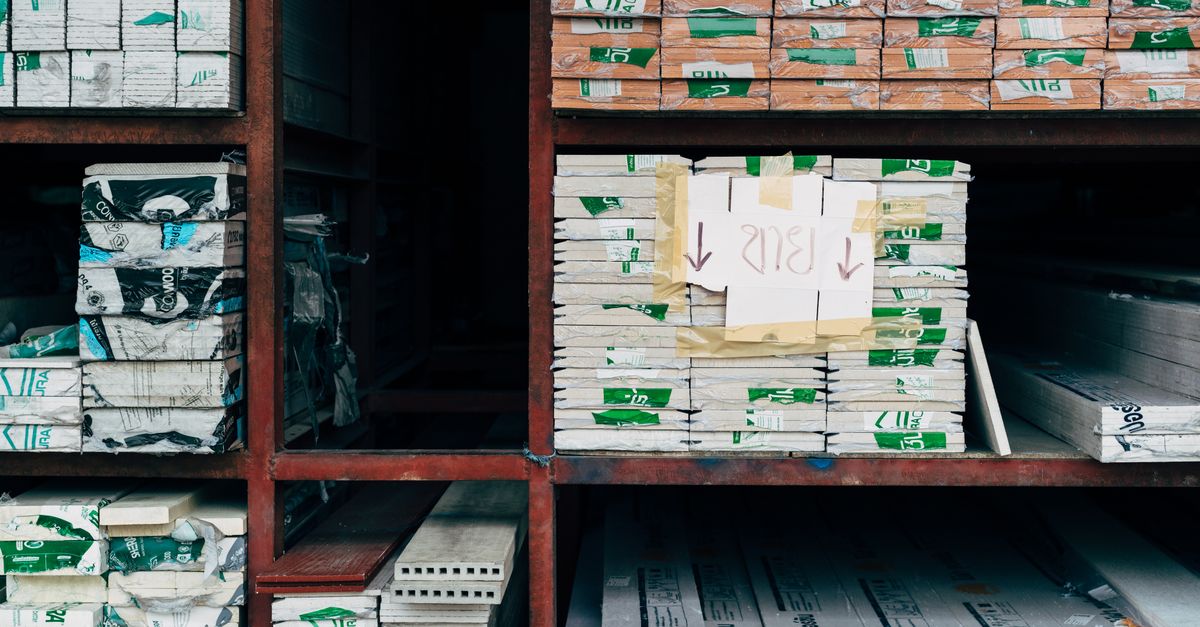
A larger purchase can lower the cost per unit while weakening the company's finances. This happens when the purchasing saving is smaller than the cost of holding the goods until they sell, or when payment falls due before the business has the cash to support it. The useful question is therefore broader than how much the supplier will discount: how much remains, how long will it take, and what demand must materialize?
The discount appears on the invoice; the costs continue afterward
Carrying inventory means committing money, space and operating capacity while products wait for buyers. Storage, damage, expiry, theft, markdowns and the cost of capital can all affect the result. Even goods kept in perfect condition and eventually sold at the planned price can consume significant resources while waiting. Stock also requires work: receiving, checking, locating, counting and picking it must fit around the company's other activities.
Buying ahead can offer concrete advantages. A business may reduce freight charges, prevent stockouts, secure favorable commercial terms and fulfill orders faster. Those advantages depend on the relationship between purchase quantity, sales speed and payment capacity. A batch that makes economic sense for one shop may be excessive for another with the same contribution margin but less predictable demand.
The method used here compares alternatives serving the same commercial need, makes assumptions explicit and follows the money over time. Every amount and percentage in the examples is hypothetical arithmetic, not a market quotation, a legal or tax threshold, or an expected business result. The purpose is to make the decision understandable and checkable, including the conditions under which an apparent saving could disappear.
Separate margin, markup and available cash
Consider a product purchased for R$ 50 and sold for R$ 80. The R$ 30 difference equals 60% of its purchase cost: R$ 30 divided by R$ 50 is 0.60. As a share of sales revenue, however, that same difference is 37.5%, calculated as R$ 30 divided by R$ 80. Confusing markup on cost with margin on revenue overstates the share retained from each sale.
Now assume variable selling expenses of R$ 10 per unit. For simplicity, this amount groups the applicable transaction expenses, such as commission, outbound packaging and other relevant charges. Unit contribution becomes R$ 20: the R$ 80 selling price less R$ 50 acquisition cost and R$ 10 variable selling expenses. The contribution margin is 25% of revenue. This contribution helps cover fixed expenses and build the business's overall result.
Contribution is not net profit. Rent, administrative staff and other commitments still belong in a complete assessment of the business. A sale and its collection may also occur at different times. A transaction with positive contribution can put pressure on cash if the supplier is paid immediately but the customer pays later. Revenue recorded in the accounts does not necessarily mean money is available in the bank.
Keep three questions separate when evaluating a purchase: does each unit contribute positively, does the batch produce a favorable result after carrying costs, and can the company fund the financial gap? A favorable answer to the first does not settle the other two. This distinction prevents an attractive sales margin from becoming a blanket justification for holding any quantity of stock.
Compare purchases that serve the same demand
The main example assumes demand of 250 units a month over six months, totaling 1,500 units. The selling price is R$ 80 and variable selling expenses are R$ 10 per unit. The product does not expire during the period. The initial comparison assumes every unit sells, with no returns, losses or price reductions. These are working assumptions that make the alternatives comparable, rather than outcomes the business can take for granted.
Under the replenishment alternative, the company buys 1,000 units initially at R$ 50 each, then another 500 at the same cost when the first batch runs out at the end of month four. Total acquisition spending is R$ 75,000. Under the larger purchase alternative, it buys all 1,500 units immediately at R$ 47.50, paying R$ 71,250. The 5% discount saves R$ 3,750 on the same 1,500 units.
Comparing only the initial R$ 50,000 payment with R$ 71,250 reveals an additional initial cash requirement of R$ 21,250, but does not measure total purchasing savings. The later R$ 25,000 replenishment belongs in the first alternative. Comparing the result from selling 1,000 units with the result from selling 1,500 would also be misleading: some of the difference would reflect sales volume rather than the discount.
Both alternatives provide the same customer service, with freight already included in acquisition costs. Replenishment is assumed to be available exactly when needed, without a stockout. Different delivery times, freight charges, quality or availability must be included if they apply. A fair comparison holds the service outcome constant while exposing unequal conditions, so a cheaper invoice does not conceal a different operating commitment.
Measure inventory by how long it stays
Inventory exposure combines quantity with time. One useful measure is the unit-month: one unit held for one month equals one unit-month, while 100 units held for two months equal 200 unit-months. This measure allows different purchasing schedules to be compared. Buying earlier increases the period of commitment even when the business eventually sells exactly the same quantity.
In the example, sales occur evenly. The first batch of 1,000 units declines gradually to zero over four months, averaging 500 units during that interval. This produces 2,000 unit-months. The second batch of 500 lasts two months, averages 250 units and adds 500 unit-months. The replenishment strategy therefore accumulates 2,500 unit-months over the full six months.
The larger purchase starts with 1,500 units and ends with none after six months. Average inventory is 750 units, producing 4,500 unit-months. It therefore adds 2,000 unit-months of holding time. These are not additional goods sold; the same demand is served by purchasing further in advance. The discount and any other benefits must compensate for that earlier commitment.
Actual sales rarely follow a straight line. Concentrated orders, campaigns, holidays and delays change the inventory curve. Average balances explain the mechanism, but a business with substantial fluctuations should project weekly or daily balances. Safety stock and delivery lead times must also be considered in an operational plan. They are excluded from this first calculation so its arithmetic remains easy to verify; their absence should not be mistaken for evidence that they are unnecessary.
Break down carrying costs without counting them twice
Assign inventory a hypothetical capital cost of 1% per month on its acquisition value while held. This is an exercise assumption, not a quoted rate or recommendation. For replenishment, 2,500 unit-months multiplied by R$ 50 produces R$ 125,000-months of capital committed. At 1%, the cost is R$ 1,250. For the larger purchase, 4,500 multiplied by R$ 47.50 produces R$ 213,750-months and a cost of R$ 2,137.50.
Add a hypothetical operating storage cost of R$ 0.50 per unit-month, representing time-related expenses relevant to the choice. Replenishment incurs R$ 1,250 under this component; the larger batch incurs R$ 2,250. These costs are separate from the R$ 10 variable selling expenses: selling expenses follow the transaction, whereas the storage component follows the period during which goods remain in inventory.
Total carrying cost is R$ 2,500 for replenishment and R$ 4,387.50 for the larger purchase, a difference of R$ 1,887.50. Real businesses must examine which costs actually change. If warehouse rent is identical under both options, it may not be an incremental expense of this decision. If the larger batch requires external storage, the full additional expense belongs in the comparison.
The company's own money has an economic cost even when it creates no monthly bank payment. Loan interest and fees, by contrast, are contractual cash outflows. Do not automatically add an estimated capital cost to the same financing cost already represented within it. Count each effect once, explain what the estimate covers and distinguish the economic assessment from the schedule of actual payments. This distinction also matters when comparing internal funding with external financing.
Complete the comparison and calculate the net advantage
Both alternatives generate R$ 120,000 in revenue from 1,500 units sold at R$ 80. Both incur R$ 15,000 in variable selling expenses, calculated as 1,500 multiplied by R$ 10. Under replenishment, deducting R$ 75,000 of acquisition costs leaves R$ 30,000 of contribution before carrying costs. After R$ 2,500 of carrying costs, the amount remaining for this comparison is R$ 27,500.
Under the larger purchase, acquisition costs of R$ 71,250 leave R$ 33,750 before carrying costs. Deducting R$ 4,387.50 leaves a comparable balance of R$ 29,362.50. Under all the stated assumptions, the larger batch has an economic advantage of R$ 1,862.50. A second calculation confirms it: R$ 3,750 in purchasing savings minus R$ 1,887.50 in additional carrying costs.
Neither balance is the company's net profit. The exercise isolates the components needed for this choice and excludes other operating effects and fixed expenses. It also does not establish that a 5% discount always justifies six months of inventory. The result depends on uniform sales, an unchanged selling price, no losses and replenishment remaining available at the assumed cost. A change in any of these assumptions can change the conclusion.
The R$ 1,862.50 advantage requires an additional R$ 21,250 at the outset. That commitment may suit a business with ample cash but be unsuitable for one needing the money for payroll or more important replenishment. The economic result informs the choice alongside liquidity constraints and opportunities forgone. The relevant question is whether the business can support the commitment throughout the cycle, including a weaker sales outcome.
Draw the cash timeline before approving the purchase
To examine cash, now assume customers pay immediately and the R$ 10 variable selling expenses are paid with each sale. Monthly cash generation before carrying costs is R$ 17,500: 250 units multiplied by R$ 70. This financial timeline uses the same sales as the main example but excludes carrying costs from the displayed balances, allowing merchandise payments and trading inflows to be seen clearly.
For replenishment, cumulative project cash starts at negative R$ 50,000. It reaches negative R$ 32,500 after month one, negative R$ 15,000 after month two and positive R$ 2,500 after month three. Month-four sales bring it to positive R$ 20,000. Buying the next 500 units for R$ 25,000 reduces it to negative R$ 5,000. It ends month six at positive R$ 30,000, before carrying costs.
The larger purchase starts at negative R$ 71,250. Cumulative cash is negative R$ 53,750 after month one, negative R$ 36,250 after month two, negative R$ 18,750 after month three and negative R$ 1,250 after month four. It becomes positive during month five and finishes month six at positive R$ 33,750, before carrying costs. The larger batch keeps the project dependent on its initial funding for longer.
These figures describe the purchasing project, not the company's total bank balance. Add actual storage payments, financing payments and other obligations on their relevant due dates. If customers instead pay 30 days after sale, an initial period has no receipts and some collections arrive after month six. The cash projection must then be rebuilt. Goods may have left the warehouse while their value remains tied up in receivables rather than available cash.
Turn demand signals into a forecast that can be checked
An assumption of 250 units a month is useful only if its origin is understood. Historical sales, confirmed orders, sales inquiries and stated buying intentions carry different weight. A quotation request may go nowhere, an order may be canceled and a completed sale may be returned. Planning should preserve these distinctions instead of grouping every signal under the single label of demand.
Historical data also needs interpretation. A week without sales may reflect a stockout rather than lack of interest. An unusually low promotional price may have brought forward purchases that would otherwise occur later. One large customer may account for a substantial share of sales. Identify unavailable periods, promotions, exceptional orders and channel changes before treating a historical average as a repeatable pattern.
A practical forecast records a range and the reasons supporting it. The reference scenario might retain 250 units a month, while an adverse scenario uses 200. A stronger scenario can help prepare replenishment, provided it is not treated as certain sales. Record what must happen for each scenario to hold, such as order conversion or price stability. This makes later review more useful than simply labeling a forecast optimistic or conservative.
Evidence must relate to the specific product and purchasing horizon. Growth across the shop does not prove that a particular color or size will turn over at the same rate. Separating demand by item, channel and region can expose excess hidden within an average. Updating forecasts with net sales, cancellations and available balances allows future orders to change before excess stock forces a clearance. Keep the forecast's assumptions visible as new information replaces earlier expectations.
Coordinate coverage, replenishment and safety stock
Inventory coverage expresses stock as time available to serve demand. At 250 units a month, 1,000 units provide four months of coverage and 1,500 provide six. This assumes constant demand. If sales fall to 200 units a month, the same 1,500 units cover seven and a half months. The physical quantity is unchanged, but the money remains committed longer.
Replenishment also depends on the interval between placing an order and having goods ready to sell. With hypothetical demand of ten units a day and a five-day delivery lead time, 50 units are needed to cover consumption during that interval. Adding 20 units of safety stock gives a reorder point of 70 units, provided those assumptions reasonably describe the operation.
Safety stock protects against variation, but fear of running out is not enough to determine its size. Examine supplier delays, sales volatility and the consequences of a stockout. A product with no substitute, used by repeat customers, may justify different protection from an accessory with several alternatives. Investigate the actual loss caused by unavailability: not every inquiry would have become a completed sale, and not every customer responds to a delay in the same way.
The main example assumes replenishment arrives precisely when needed. With a delivery lead time, the order must be placed earlier. If the supplier also requires advance payment, some of the cash benefit of smaller purchases disappears before goods arrive. Payment terms, physical delivery time and safety stock therefore belong in the same plan. Their assumptions must be consistent: a purchase schedule cannot rely on immediate availability while its cash forecast assumes payment is deferred.
Stress-test slower sales, markdowns and losses
At 200 units sold per month, the 1,500-unit batch takes seven and a half months to sell. Using the same methods, it accumulates 5,625 unit-months and approximately R$ 5,484.38 in carrying costs. Replenishing the same 1,500 units in batches of 1,000 and 500 produces 3,125 unit-months and R$ 3,125 in carrying costs. The discount's advantage falls to approximately R$ 1,390.62.
That calculation still assumes every unit sells at the original price. At the end of the originally planned six months, 300 units from the larger batch remain. Reducing their price by R$ 8 each would cut revenue by R$ 2,400. Attribute this as an additional disadvantage of the larger purchase only if replenishment would avoid the same surplus or markdown. Otherwise, the comparison would charge one option for a problem shared by both.
Under the original demand scenario, the R$ 1,862.50 advantage equals R$ 3.725 per unit across the 500 units bought in advance of the initial 1,000-unit batch. An average price reduction exceeding that amount on those 500 units would consume the calculated advantage before other adjustments. A visible purchasing discount can therefore leave a narrow cushion against a later markdown.
Physical losses need separate treatment. Damaged goods lose revenue and may create disposal, replacement or customer-service costs. A generic loss percentage is not useful merely because it sounds cautious. Build assumptions from actual incidents, storage conditions and shelf life. Scenarios should show how money could be lost and which timely actions could limit the damage. They should also identify whether a loss affects both alternatives or becomes more likely because a larger batch stays longer.
Allocate business capital across items with different behavior
A purchase can be attractive on its own while harming the overall inventory position. Suppose the extra R$ 21,250 required for the larger batch prevents replenishment of products customers request every week. The comparison must then include contribution lost on those sales and any associated customer loss. The discounted item should not be evaluated as though the money had no other business use.
Classifying items by sales frequency, predictability and contribution helps establish purchasing priorities. A high percentage margin can coexist with months of slow sales. Another product with lower unit contribution may complete several purchasing and sales cycles in the same interval. This does not automatically make it preferable: sales effort, operating capacity and risk also vary. Consider how the products actually use the company's limited resources.
In clothing retail, a collection may sell well overall while leaving substantial quantities in particular sizes. In a building materials shop, a slow-moving part may be needed to complete larger orders. These relationships matter. Removing every slow seller can undermine service, while buying heavily across every variation can create inventory that appears diverse but is difficult to turn into cash.
A purchasing review should distinguish items essential to service, those supported by stronger demand evidence and those depending on a weaker commercial assumption. For the last group, smaller batches or more frequent replenishment may justify a higher unit cost. The decision concerns where to commit business capital and where to retain the ability to change direction as demand becomes clearer. It is an operating judgment about inventory, not a prescription for anyone's personal investment allocation.
Negotiate the complete terms, beyond price
A supplier may offer a discount to gain predictability, reduce dispatches or transfer inventory to the buyer. Understanding that interest creates room for alternatives. Instead of accepting only a choice between a large batch and full price, the business can propose a volume commitment with staged deliveries, revised minimum quantities by item or an agreed replenishment window. Each proposal should address the supplier's needs as well as the buyer's constraints.
If 1,500 units are negotiated together but delivered and paid for in installments, some savings may be retained with less capital tied up. This requires supplier agreement and clear terms: whether the volume is binding, when ownership and risk transfer, cancellation rights and what happens if demand falls. Staged delivery with full advance payment can solve a space problem while leaving the financial commitment largely intact.
Payment time has value too. A R$ 50 price with later payment may be better for cash than R$ 47.50 paid immediately, despite its higher acquisition cost. Compare complete flows: amounts, due dates, freight, purchasing obligations, quality and consequences of late payment. Do not attach invented monetary values to commercial benefits merely to make a preferred proposal appear to win.
Exchanges of slow-moving items, defective-goods returns, batch consistency and service lead times can matter as much as a few percentage points of discount. Record the accepted terms and check commercial documentation before relying on them. A verbal exchange promise should not support a large order when contractual restrictions say otherwise. Negotiation improves the plan when it produces commitments that can be understood, verified and reflected in purchasing and cash projections.
Assign responsibilities and resolve disagreements with evidence
Purchasing sees the price opportunity; sales sees additional customer demand; finance sees payment pressure; operations sees limits on space and handling. Each perspective reveals part of the decision. Conflict arises when one departmental target dominates. Rewarding only acquisition savings can encourage excess, while insisting only on minimum inventory can cause shortages of important products.
Identify responsibility for the main assumptions in a purchase proposal. Sales supplies demand evidence; purchasing confirms prices, payment terms and conditions; operations checks receiving and storage capacity; finance projects cash alongside other obligations. In a small company, one person may perform several roles. The checks should still be made separately so that confidence in the price does not substitute for checking demand or the payment schedule.
If people disagree about sales of 250 versus 200 units a month, choosing a convenient midpoint does not resolve the uncertainty. Record each estimate's reasoning, calculate both outcomes and decide which exposure the company can absorb. The order might be reduced, divided or made conditional on observed sales. Documented disagreement helps reveal which assumption actually supports the purchase and what evidence would justify changing it.
Also define who can stop scheduled replenishment and under what conditions. If turnover weakens, the team needs authority and criteria for renegotiating the next batch, scaling back a campaign or reviewing prices. Relevant remuneration, commissions and supplier relationships should be disclosed to those approving the decision because they may influence recommendations. Clear criteria make disagreement manageable without requiring everyone to predict the same future, and make it easier to act before another binding order increases the exposure.
Correct mistakes before the next purchase repeats them
A common mistake is tracking only purchased quantities and revenue while ignoring the age of remaining stock. The business sells part of a batch, celebrates the revenue and loses sight of older units still consuming resources. Track receipts, issues and holding time by batch or another grouping appropriate to the product. Include expiry and physical condition where relevant, rather than assuming a recorded balance remains equally saleable.
Another mistake is treating gross sales as evidence of turnover. Cancellations and returns can put goods back into inventory and remove expected cash receipts. Items may also be reserved for orders that never complete. Reconcile net sales, physical availability and delivery commitments to avoid buying against departures that existed only in the system. Investigate inventory discrepancies instead of automatically covering them with additional purchases.
Common economic errors include treating the discount as profit, forgetting later replenishment and duplicating expenses. The example provides a useful cross-check: R$ 1,862.50 appears both as the difference between comparable results and as purchasing savings less additional carrying costs. If the methods do not agree, look for a missing component, inconsistent basis or arithmetic error. Agreement checks the calculation, although the underlying demand and cost assumptions still need evidence.
When excess already exists, first stop repeating the order and reassess realistic sales. Moving goods between locations, offering useful bundles or negotiating exchanges may help. Before marking down prices, calculate contribution, campaign expenses and effects on other products. Selling below cost can release cash in some circumstances, but realizes a loss that must be recognized. Partial recovery of money is not profit; distinguish the cash recovered from the economic loss accepted.
Document the purchase when external capital is needed
If the purchase requires external funding, explain the use of proceeds: which goods will be bought, their cost, expected sales timing and the cash gap to be covered. The batch calculations, scenarios and ability to absorb losses are more useful than a generic claim about a promising market. Potential funders need enough information to understand both the operation and the uncertainty, including what happens if sales disappoint.
KEZS connects entrepreneurial projects and potential funders through technology and intermediation. In that context, transparent documentation can make a proposal easier to understand and support questions about purchasing, turnover and demand. Investors perform their own due diligence and make their own decisions; KEZS does not assign a credit score. Presenting a project provides no guarantee of approval, repayment, profitability, liquidity or preservation of capital.
Funding forms create different rights and risks. A loan creates contractual repayment obligations. Receivables financing depends on existing, eligible claims, not merely hoped-for sales. Equity involves ownership rights and business risk; convertible instruments depend on their terms. A Brazilian MEI cannot admit equity partners while remaining a MEI. A donation to a nonprofit is neither an equity investment nor a promise of financial return.
Assess costs, any required collateral, conflicts of interest and consequences of weaker sales. Public securities distributions and regulated financial activities require appropriate structures and providers under applicable Brazilian rules; technology or a CNAE classification is not authorization. Give private documents controlled access rather than placing them on public blockchains. Blockchain record integrity does not establish the truth of demand, legal title, reserve solvency or payment assurance. Reference sources are starting points for investigation, not evidence that KEZS holds regulatory authorization.
Approve the purchase within limits and monitor the outcome
Before ordering, prepare a decision record covering the product, quantity, complete cost, payment terms, expected coverage and demand evidence. Include the replenishment comparison and peak cash requirement. Here, it would show R$ 3,750 of purchasing savings, R$ 1,887.50 of additional carrying costs, a R$ 1,862.50 economic advantage and an extra R$ 21,250 initial outlay. Keep the assumptions with the figures so later readers understand what supports them.
Explain why the commitment fits the business. If available cash cannot support the larger batch alongside essential obligations, the calculated saving is insufficient grounds for approval. Even if it can, assess the adverse scenario and alternative uses of the money. Exposure limits can be expressed as a monetary amount, coverage period or quantity, provided they connect to financial and operating capacity.
After purchase, monitor net sales, collections, inventory age and projected cash at a frequency suited to the product. Decide in advance what requires review. For example, sales below the adverse scenario for two monitoring periods might trigger suspension of an order that remains cancelable. A trigger should open an assessment, considering delivery delays and other explanations for the deviation, rather than automatically treating every variance as proof that the original decision was wrong.
At the end of the cycle, compare forecast and actual selling prices, quantities, losses, collection timing and carrying costs. Separate mistaken assumptions from execution problems and external events. This review improves the next negotiation and prevents repeating a purchase simply because it carried a discount. Increasing stock works better when the business can explain the connection between goods purchased, demand served and capital returning to cash, while recognizing the costs and losses incurred along the way.
Frequently asked questions.
What minimum discount justifies buying a larger batch?
There is no universal percentage. Compare acquisition savings with additional carrying costs, freight changes, expected losses and other cash needs. Here, R$ 3,750 of savings less R$ 1,887.50 of additional carrying costs leaves R$ 1,862.50 under the assumptions used. Finding a break-even discount also requires recalculating capital cost because that cost depends on the purchase price itself. Dividing a fixed cost by the order value may offer an approximation, but must not conceal this dependence or demand risk. A discount that breaks even economically may still require more initial cash than the business can support.
Can I ignore capital cost if I use the company's own money?
Do not invent a cash installment that does not exist. In an economic comparison, however, internal funds have alternative uses, including replenishment, expenses and an operating reserve. Use an explicit capital-cost assumption and test its effect on the decision, without presenting the percentage as mandatory. Keep the schedule of actual payments separate. This explains why a purchase can show a saving while committing resources needed elsewhere in the business. If financing is involved, identify which interest and fees are already represented so that the same cost is not counted twice.
Does a higher contribution margin mean I should hold more stock?
Contribution margin shows what each sale contributes after the relevant variable costs and expenses. It does not establish sales frequency, collection timing or surplus risk. A high-contribution product may remain unsold for months, while a lower-contribution item turns over repeatedly. Appropriate quantities depend on demand by item, replenishment lead time and the ability to fund the gap. Service relationships matter too: cutting a complementary product too far can undermine larger orders. Combine margin and turnover with the item's operating role, rather than treating any one measure as a complete purchasing rule.
How should I account for a possible supplier price increase?
Treat the increase as a scenario supported by available evidence about its likelihood and size. A supplier communication is more concrete than a general fear, but its terms and applicability still need checking. Calculate how much replenishment would cost and compare that difference with carrying costs and early-purchase risk. Also test weaker demand and the possibility that customers will not accept a higher selling price. Buying ahead may be reasonable, but the benefit is confirmed only to the extent that the future cost actually occurs and the goods find buyers. Do not turn an uncertain increase into a certain saving.
Can forecast future sales be treated as receivables?
No. A forecast estimates transactions that may happen. An existing receivable arises from an established relationship and must still meet the eligibility conditions of the proposed financing arrangement. Cancellations, returns, disputes and debtor concentration may affect the assessment. Separate orders, completed sales and actual receivables in the plan. An inventory purchase is not covered by receivables merely because sales are expected later. If receivables financing is used, include its costs, maturities and contractual responsibilities in cash flow. Check who bears the consequences if the underlying debtor fails to pay or the claim is challenged.
What should purchasing and finance do when they disagree about a discount?
Put both proposals on the same basis: demand served, time horizon, complete costs, payments and an adverse scenario. Purchasing may correctly identify unit savings while finance correctly identifies a cash shortage. Both findings can be valid. Explore terms that retain part of the benefit with less exposure, such as staged deliveries and payments or a smaller initial order. If the disagreement concerns sales forecasts, record each estimate's evidence and calculate its consequences. The final decision should state which risk was accepted, who will monitor results and what developments require review.
When should I reduce the price of slow-moving inventory?
Consider likely sales without a discount, deterioration, the cost of waiting and the promotion's effect on other sales. Estimate the cash released, additional expenses and remaining contribution, then compare them with holding the goods longer. Do not assume a future full-price sale is certain. First check product display, system availability and distribution across channels or locations. If clearance is necessary, recognize the economic loss and use the outcome to correct future quantities. Recovering cash can be useful even when it does not recover the full acquisition cost, but that recovery should not be described as profit.
References and context
Institutional reference points for checking applicable rules and guidance. Calculations and scenarios are original examples, not quotes, historical results or individualized recommendations.
- Banco Central — correspondentes no País ↗
- CVM — Resolução 88, texto e alterações ↗
- CVM — Resolução 175, fundos de investimento ↗
- Portal do Empreendedor — perguntas sobre MEI ↗
- ANPD — orientações e perguntas frequentes ↗
AI-assisted educational content. Decisions require verification of the information, instruments and providers in each actual case.